My shopping cart
Your cart is currently empty.
Continue ShoppingQuick Summary
The best concrete systems for a residential project depend on whether you are building structure or finishing surfaces, your climate, budget, and schedule. Poured reinforced concrete is the traditional baseline, while insulated concrete forms, precast panels, and microcement each suit different goals. Match the system to the job before comparing prices.
Last Updated: October 30, 2026
Choosing the right concrete systems for a home is less about finding the single "best" product and more about matching a system to your budget, climate, lot, and build schedule. At DF Studio NYC, we supply professional-grade concrete and surface systems to contractors and homeowners. This guide walks through the options and the trade-offs that matter most.
Start with four questions. What structure are you building or renovating? What climate and soil conditions will it face? What is your real installed budget, not just material cost? And who will do the work? The answers narrow the field quickly. A homeowner adding a finished basement floor has very different needs than a builder erecting a full exterior wall system.
Watch out: many buyers compare material prices and overlook pumping, labor, curing time, and finish costs. A cheaper bag of material can cost more once a crew is billing by the day.
| Question | Why it matters | Typical system fit |
|---|---|---|
| Structural or finish work? | Structural walls need engineered reinforcement | Poured reinforced concrete or ICFs |
| Interior or exterior surface? | Exposure drives sealing and wear needs | Microcement interiors, sealers outdoors |
| Existing slab or new pour? | Substrate condition limits options | Self-leveling underlayments and overlays |
| Budget and timeline | Labor and cure time differ widely | Precast panels for faster erection |
Poured-in-place reinforced concrete is the baseline against which other residential concrete systems are measured. It uses formwork, steel reinforcement, and cast-on-site concrete to create foundations, slabs, and structural walls. Its strength and fire resistance are well understood, which is why many building departments are familiar with it.
The trade-off is time and labor. Forming, reinforcing, pouring, and curing take weeks, and weather can delay each step. Many homeowners find the system works best where the design is conventional and the crew is experienced with cast-in-place work.
For slabs and foundations, the system pairs well with the self-leveling underlayments discussed later, which give the finished floor a flat, consistent base.
Insulated concrete forms are hollow foam blocks or panels, typically expanded polystyrene (EPS) or a EPS-cement blend, stacked into a wall, reinforced with rebar, and filled with concrete. The foam stays in place as permanent insulation, so the wall is insulated the moment it is finished. Unlike a poured wall that later gets framed and insulated, an ICF wall combines structure, insulation, and often furring strips for finishes in a single assembly.
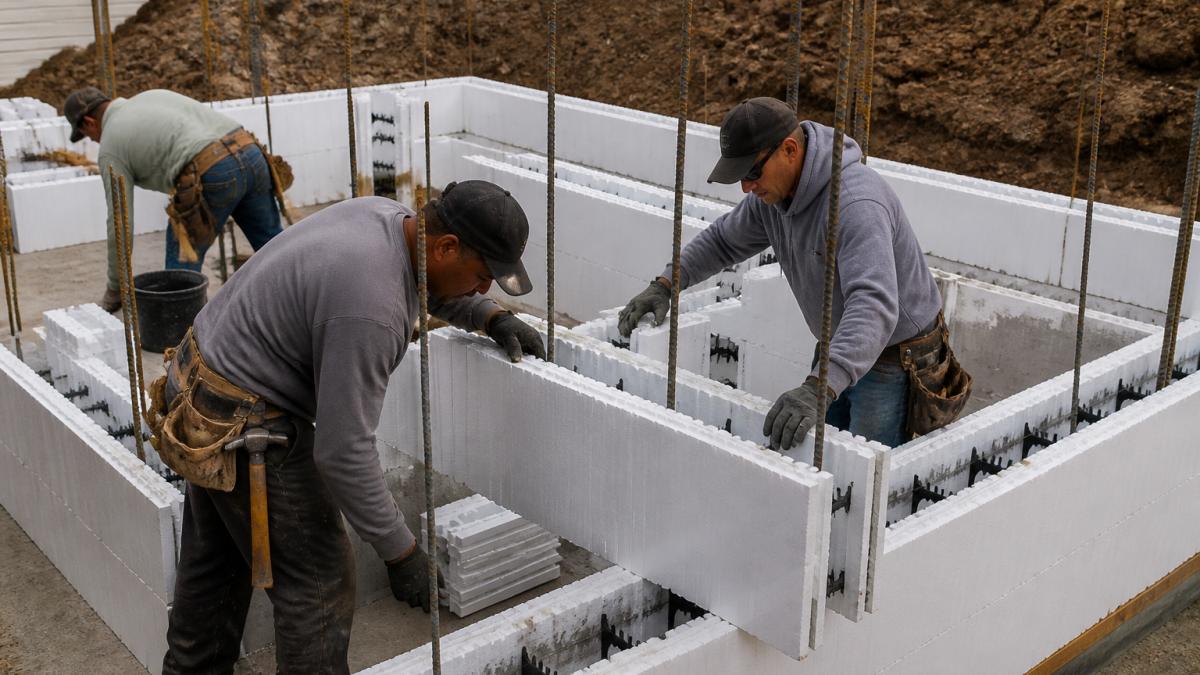
Common mistakes. Skipping the bracing plan is the classic error, fresh concrete exerts real pressure on the forms, and inadequate bracing is a frequent source of blowouts and field problems. Other frequent issues: not planning window and door openings before the pour, failing to protect the foam from UV and construction damage, and under-specifying the concrete mix or consolidation. Confirm the product's fire and energy ratings with the manufacturer and your local inspector before ordering.
Precast concrete panels and modular components are manufactured off site and craned into place. Because the work happens in a controlled plant, quality is consistent and erection on site can be fast. This makes precast attractive where the lot is tight, the schedule is compressed, or weather is unpredictable.
The limits are transport, crane access, and joint detailing. Heavy panels need a clear route and a sized crane, and joints between panels must be sealed carefully to prevent water entry. Expect the design to be set early, since changes after fabrication are costly.
Microcement is a thin, cement-based decorative finish applied over floors, walls, and feature surfaces. If you want to try the look yourself, the SEMCO X-Bond Microcement System Starter Kit includes the materials to get started. It creates a seamless, modern look with no grout lines. Its benefits for home interiors include a continuous surface, many colors, and suitability for wet areas when properly prepared and sealed.

Our microcement supplies include the SEMCO X-Bond Microcement System Starter Kit at $249.89. For a finished surface, the SEMCO Microcement Decorative Finish Kit is priced at $607.55.
Microcement is less forgiving of poor preparation than tile. Substrate condition, moisture, and sealer choice determine how the finish performs, so a sample first is strongly recommended. Compared with polished concrete, microcement is applied as a thin layer rather than ground from the existing slab, which suits renovations where the original floor cannot be reworked. For a direct side-by-side look at the two options for wet areas, see microcement vs polished concrete for bathrooms.
Overlays, underlayments, and sealers prepare and protect concrete after the structure is in place. Self-leveling underlayments create a flat base for flooring, and some can remain exposed as a wear layer. Sealers protect against water, oil, and salt. These protective measures become even more critical when scaling these techniques for high-traffic commercial concrete flooring.
Our underlayment range includes Bostik SL-175 Premium Self-Leveling Underlayment & Wear Layer, Bostik SL-100 UNDERLAYMENT at $24.99, Bostik SL-Gyp at $39.99, Velosit SL 502 at $47.99, and Velosit SL 503 at $65.99. For protection, the EcoFirm Epoxy System is $180.00, and the Ghostshield Siloxa-Tek 8510 is $159.88. Always confirm the technical data sheet for coverage, working time, and substrate suitability.

Traditional poured driveways are durable but can crack and stain, and replacement is disruptive and costly. The practical question for most homeowners is not "concrete or something else" but "resurface, replace, or switch systems", and the answer depends on whether the existing slab is structurally sound.
Resurface (overlay or sealer). If the slab is sound but stained or lightly cracked, a thin overlay or a penetrating sealer may be a suitable path. Ghostshield Siloxa-Tek 8510 is a deep-penetrating sealer, and the EcoFirm Epoxy System is an epoxy system; both should be evaluated against the slab's condition. Overlays hide surface damage but cannot fix a failing base, inspect for heaving, large cracks, and drainage problems first.
Replace with a different system. When the base has failed, replacement opens the door to other systems:
How to compare the options. Ask contractors for bids that separate demolition, base preparation, drainage, material, labor, and sealing, and compare total cost rather than first cost alone. Check local code and HOA rules before choosing.
Once you have matched a system to your project, the next step is ordering and scheduling. Confirm quantities against coverage rates on each technical data sheet, allow for waste, and plan delivery around your crew's cure times. Our team can help match products to your project; you can search our catalog for the specific system you have chosen.
Polished or decorative concrete slabs and self-leveling cementitious underlayments are among the most durable residential flooring options when properly prepared and sealed. SL-175 is a premium self-leveling underlayment and wear layer. Velosit SL 503 is a polishable overlayment rated for foot traffic after 3 hours and forklift traffic after 16 hours. Durability depends on substrate preparation and a compatible sealer; Ghostshield Siloxa-Tek 8510 is one sealer option for concrete surfaces.
Neither is universally better. Poured-in-place reinforced concrete suits custom foundations and irregular layouts, while precast panels and modular components can reduce on-site pours and shorten schedules when the design is standardized. Precast work depends heavily on delivery access, crane capacity and joint detailing, so compare total installed cost and timeline for your specific lot. Confirm the structural design with a licensed engineer and your local building department before committing to either approach.
Common alternatives include permeable pavers, stamped or overlaid concrete, and self-leveling cementitious surfaces sealed for oil and salt resistance. Ghostshield Siloxa-Tek 8510 is a deep-penetrating sealer for concrete surfaces. Test a small area first, since absorption varies with the surface, and confirm drainage and local stormwater rules for your property.
Microcement is a thin, cement-based decorative coating applied in skim coats rather than a structural slab, so it is used for walls, floors and feature areas over a prepared substrate. The SEMCO Microcement Decorative Finish Kit is one option for decorative microcement finishes. It creates a seamless, grout-free look, but it requires proper priming, sealing and a sound base, and it is not a replacement for structural concrete.
ICF walls are hollow foam forms filled with reinforced concrete, which combines structural walls with continuous insulation. Check local code requirements and engage an experienced ICF installer before finalizing the design.
