My shopping cart
Your cart is currently empty.
Continue ShoppingLast Updated: October 26, 2026
Quick Summary
Microcement finishes are cement-based coatings, typically 2-3mm thick, that bond directly to existing concrete, tile, or wood to create a seamless, polished surface with no grout lines. They deliver durability, water resistance, design flexibility, and low maintenance in a single application, ideal for bathrooms, kitchens, and high-traffic spaces.
Microcement finishes are cement-based coatings, typically 2-3mm thick, that bond directly to existing concrete, tile, or wood to create a seamless, polished surface with no grout lines.
Tri-state contractors and homeowners choose microcement because it solves renovation fatigue: instead of weeks of dusty tile removal, it sits on top of what's already there.
Beyond aesthetics, microcement finishes deliver durability, water resistance, design flexibility, and low maintenance in a single application, ideal for bathrooms, kitchens, and high-traffic spaces.
A seamless finish eliminates the grout lines, joints, and visual breaks that fragment a space. Where traditional tile creates a grid pattern, microcement forms one continuous surface from wall to floor, corner to corner.
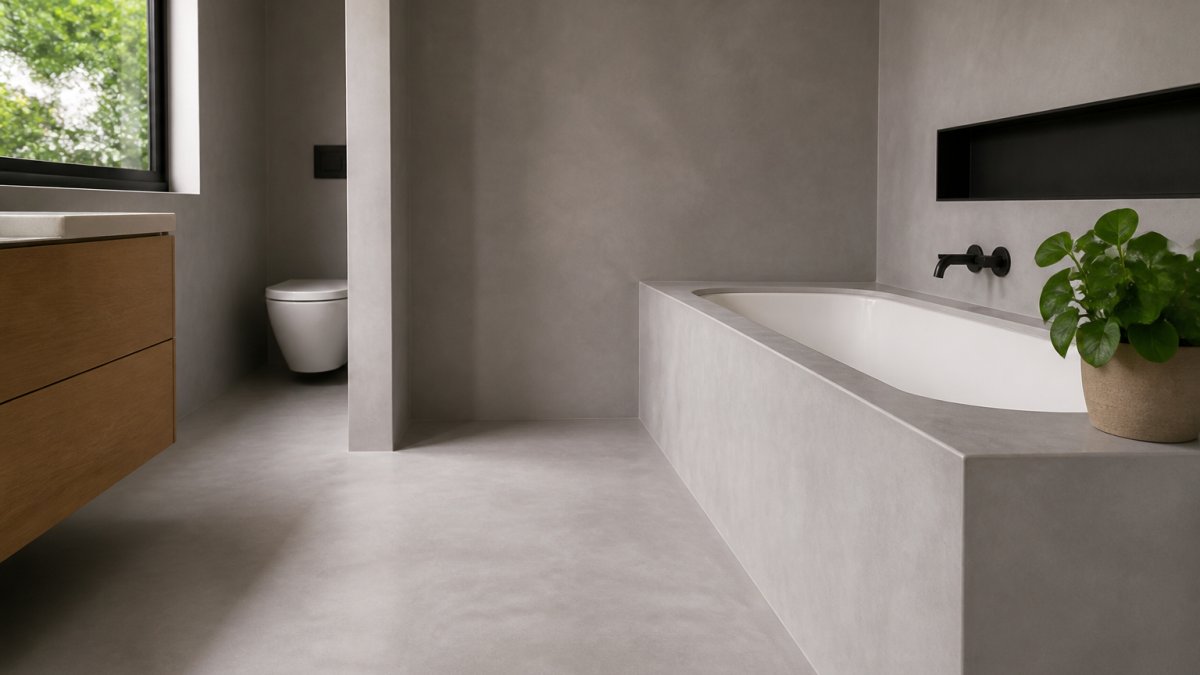
The eye travels uninterrupted across the surface: smaller bathrooms feel larger, kitchens feel more cohesive, and the space reads as intentional rather than assembled from separate pieces.
Grout-free design also removes a maintenance headache: no grout to collect dirt, mold, and stains or need sealing and replacement, a simple wipe-down keeps microcement clean.
Installation is also faster than tile removal and replacement: bonding to existing substrates avoids demolition, disposal, and structural work, translating to lower labor costs and faster occupancy.
Water resistance is non-negotiable in bathrooms and wet rooms. Properly sealed microcement finishes resist water penetration: a protective sealer creates a barrier that keeps water from reaching the substrate.
That makes microcement finishes ideal for bathroom floors, shower walls, and wet rooms, where they won't absorb water, swell, or deteriorate under humidity and splashing the way porous concrete or unprotected cement would.
The key to long-term water performance is the sealer application. A quality protective sealer, like the Semco Satin Stone Sealer (A + B), locks in water resistance and prevents staining.

Microcement, applied correctly with proper sealing, stays water-resistant for years in humid climates without ventilation workarounds or constant maintenance, making it a common specification for bathrooms.
Durability is where microcement marketing and reality diverge.
Expected service life. A properly installed and maintained interior microcement floor commonly delivers 10 to 20 years of service before a full refresh is needed.
What actually causes failure. In practice, most microcement problems trace to one of four causes, none of which are the material's fault:
Impact and abrasion. The hard, dense cement matrix resists foot traffic, rolling loads, and dropped objects better than paint, thin resin, or vinyl.
Stain resistance. Sealed microcement resists oil, wine, coffee, and common household liquids. The sealer is the barrier; the cement beneath it is porous. That means stain performance is only as good as the sealer's condition.
Repairs. Hairline cracks and small chips are patched with microcement repair compound, feathered in, and resealed, blendable because the finish is troweled, not printed.
Resealing cadence. Most residential interiors need resealing every 3 to 5 years; high-traffic kitchens, bathrooms, and commercial spaces may need it every 1 to 3 years. Resealing is a maintenance task, not a failure, it is the cost of keeping the water and stain barrier intact.
Where microcement is not the right choice. Durability claims should come with limits. Microcement is generally not recommended for exterior horizontal surfaces exposed to freeze-thaw cycling, for substrates that flex, or for areas where standing water is constant and drainage is poor. In those conditions, the failure risk shifts from the finish to the system, and no sealer fixes a moving substrate.
The durability story isn't "it never fails", it's that it fails predictably, and the causes are controllable.
Microcement pricing is one of the most searched and least honestly answered questions in the category. Here's the practical breakdown contractors use when quoting.
Installed cost per square foot. For residential projects, professionally installed microcement typically lands in the $8 to $18 per square foot range for floors and $10 to $22 per square foot for walls and shower surrounds, depending on substrate condition, number of coats, and finish.
What moves the number up or down:
SEMCO Microcement Decorative Finish Kit →
Total cost of ownership vs. tile. Ceramic tile installs for $4 to $12 per square foot, but that ignores demolition: tearing out and disposing of an existing tile floor adds $2 to $5 per square foot, plus possible substrate replacement. Microcement goes over the existing surface, so the demolition line disappears, and over 10 years it also avoids grout replacement and deep-cleaning failed grout lines.
Resealing cost. Plan on $1 to $3 per square foot every 3 to 5 years for a professional reseal, or less if you maintain the sealer with pH-neutral cleaners and touch up high-traffic zones. That recurring cost is real and should be in your budget from day one.
Repair cost. Small chips and hairline cracks are patched with microcement repair compound and blended into the surrounding finish, typically a $150 to $400 service call for a localized repair.
For smaller applications, the SEMCO X-Bond Microcement System Starter Kit offers a complete foundation at an accessible entry point; for larger or more complex projects, the SEMCO Microcement Decorative Finish Kit provides expanded capacity and design options.

The cost-benefit calculation favors microcement when renovation speed, substrate preservation, and long-term durability matter. You're paying for a faster, less disruptive installation that avoids the hidden costs of full demolition and disposal.
Maintenance of microcement finishes is straightforward compared to grout-heavy tile or raw concrete.
Daily maintenance is basic: sweep or vacuum, then wipe with a damp cloth and mild soap. Avoid abrasive scrubbers that scratch the sealer; for stubborn spills, use a soft cloth with a pH-neutral cleaner.
Periodic resealing keeps water resistance and stain protection active, every 1-3 years depending on traffic and exposure. The Semco Satin Stone Sealer (A + B) is formulated for microcement surfaces and restores protection without removing or re-applying the finish.
Watch out: Using acidic cleaners, harsh chemicals, or abrasive tools can degrade the sealer and expose the microcement to staining and moisture. Stick to pH-neutral cleaners and soft cloths to preserve the protective layer.
Address minor damage promptly: small chips or cracks can be patched with microcement repair compound before they expand, preventing water infiltration and keeping the surface looking intentional.
Both create smooth, seamless surfaces, but they differ in application, appearance, and performance.
Polished concrete grinds and seals existing concrete in place, revealing its natural aggregate. It works best on concrete already in good condition.
Microcement finishes apply as a thin coating over any existing surface, concrete, tile, wood, or stone, creating a new surface layer that works on damaged concrete, uneven tile, or non-concrete substrates where polishing isn't an option.
| Aspect | Microcement Finishes | Polished Concrete |
|---|---|---|
| Application | Thin coating over existing surface | Grinding and sealing in place |
| Substrate requirements | Works on any surface; covers damage | Requires sound concrete in good condition |
| Customization | Unlimited colors, textures, finishes | Limited to concrete's natural appearance |
| Installation speed | Faster; minimal substrate prep | Slower; requires grinding equipment |
| Repair | Easy patching with microcement compound | Requires re-grinding and resealing |
| Water resistance | Excellent when sealed | Good when sealed; depends on concrete quality |
| Cost | Moderate; varies by design complexity | Moderate to high; depends on concrete condition |
For contractors choosing between these options, the decision hinges on substrate condition and design intent. If the concrete is sound and you want its natural appearance, polished concrete works. For a deeper comparison, explore microcement versus polished concrete for bathrooms to understand application-specific tradeoffs.
Starting a microcement project begins with substrate assessment: walk the space and identify cracks, uneven areas, or damage requiring repair before application.
For your first microcement project or a small application, the SEMCO X-Bond Microcement System Starter Kit includes everything needed to begin: base coat, finish coat, and sealer components.

For larger or more complex projects, the SEMCO Microcement Decorative Finish Kit expands your options with additional materials and finish variations.
Before starting, confirm substrate preparation is complete and environmental conditions support curing.
The benefits of using microcement finishes compound over time. The seamless appearance holds up, water resistance stays intact with periodic resealing, and maintenance remains simple.
Microcement finishes solve the renovation equation most contractors face: how to deliver a high-end, durable surface without the time, cost, and disruption of full demolition.
Yes. Microcement finishes offer strong abrasion and impact resistance, making them suitable for kitchens, hallways, and commercial spaces. The protective sealer applied during installation enhances durability by guarding against stains, moisture, and daily wear. However, substrate preparation and proper sealing are critical, poor installation can lead to cracking or adhesion failure in heavy-traffic zones. DF Studio NYC supplies professional-grade systems like the SEMCO X-Bond Microcement System Starter Kit designed for demanding environments.
Microcement cost per square foot varies based on surface complexity, substrate condition, and finish type. Full system kits like the SEMCO Microcement Decorative Finish Kit ($607.55) cover larger areas, reducing per-unit costs. Demolition of existing flooring and extensive substrate repair will increase total project cost significantly.
Yes, microcement can be applied directly over existing tiles if the substrate is properly prepared. The tiles must be cleaned, abraded, and primed to ensure adhesion. However, poor substrate preparation is one of the leading causes of microcement failure, loose tiles, grout voids, or uneven surfaces can cause cracking and separation. Professional assessment of your existing surface before application is essential to avoid costly repairs later.
Microcement requires regular sealing and gentle cleaning to maintain its finish, while polished concrete is harder and more resistant to staining but can show dust and requires periodic repolishing. Microcement offers superior design flexibility and seamless aesthetics; polished concrete is more durable in extreme industrial settings. For residential and commercial interiors, microcement maintenance tips include periodic sealing with products like Semco Satin Stone Sealer and daily cleaning with pH-neutral cleaners to preserve the finish.
