My shopping cart
Your cart is currently empty.
Continue ShoppingLast Updated: October 11, 2026
Microcement and polished concrete are two distinct decorative flooring systems. Microcement vs polished concrete for bathrooms represents a critical choice because bathrooms demand waterproofing, slip resistance, and durability in high-moisture environments.
Microcement is a thin cement-based coating (1/8 inch thick) applied in multiple layers over existing substrates. Polished concrete is a mechanical process that grinds and burnishes existing concrete surfaces to create a glossy finish. The key difference lies in how each handles water exposure and substrate movement.
The choice between them depends on waterproofing requirements, slip safety, installation method, and long-term maintenance expectations. Understanding where each excels prevents costly installation mistakes and ensures the bathroom finish performs for years.
| Characteristic | Microcement | Polished Concrete |
|---|---|---|
| Thickness | 1/8 inch (minimal build-up) | Surface treatment only |
| Application | Hand-applied, multiple coats | Mechanical grinding |
| Waterproofing | Requires sealer system | Limited water resistance |
| Slip Resistance | Textured options available | Naturally slippery when wet |
| Substrate Flexibility | Handles minor movement | Requires stable concrete |
| Curing Time | 24-48 hours | Immediate use |
| Over Existing Tile | Yes, with prep | No, must remove |
Microcement's waterproofing depends on the complete system build-up: primer, base coat, decorative finish, and protective sealer. Microcement alone is porous and cannot function as a waterproofing membrane.
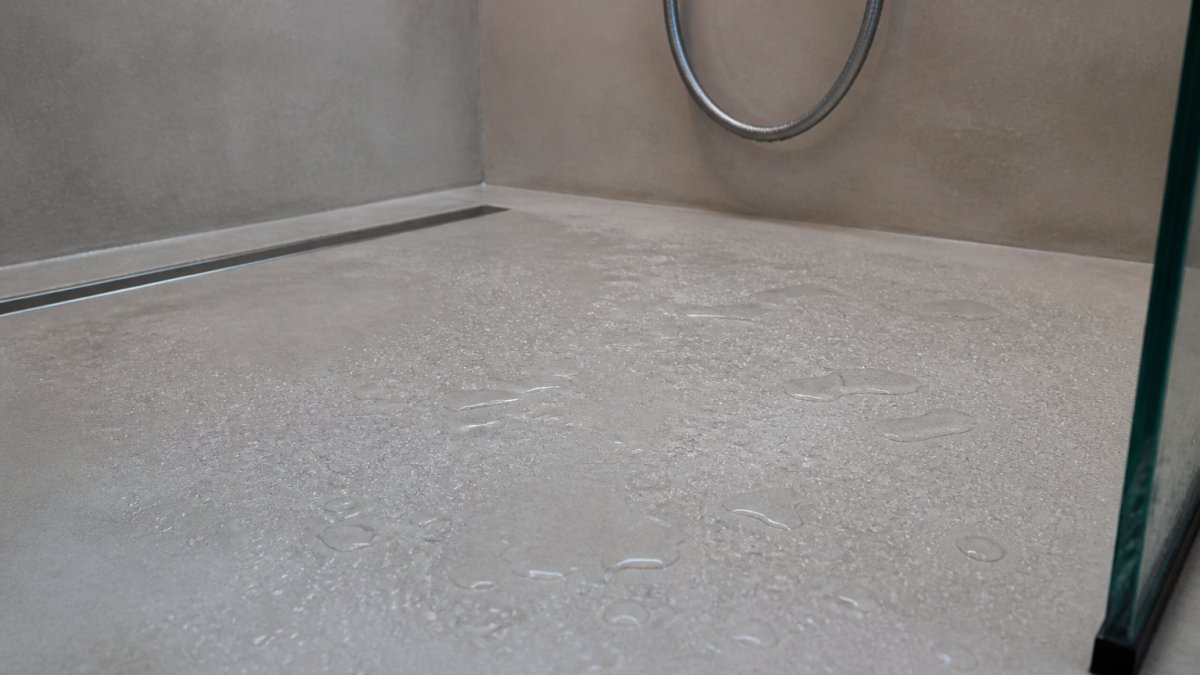
For shower floors and wet walls, a liquid waterproofing membrane beneath the microcement prevents water penetration. The microcement then sits on top, sealed with a protective coating. The SEMCO Microcement Decorative Finish Kit includes sealer options (Titan Glossy or Satin Stone) that protect the surface from water damage and staining.

Common mistakes occur when installers skip the waterproofing membrane or apply insufficient sealer. The system must be treated as a complete package: substrate preparation, waterproofing layer, microcement application, and final sealing.
Polished concrete offers no inherent waterproofing and becomes slippery when wet. Even with sealers, it cannot match the waterproofing performance of a properly installed microcement system.
Slip resistance is where microcement and polished concrete diverge dramatically in bathroom safety performance. Wet bathroom floors demand slip-resistant surfaces to prevent falls. Slip resistance depends on surface texture, sealer type, water film thickness, footwear, and user mobility.
Polished Concrete Slip Performance
Polished concrete becomes dangerously slick when wet because water forms a lubricating film between the foot and the smooth surface. Most polished concrete finishes are slippery without additional treatment. Even with anti-slip coatings, the glossy substrate limits effectiveness. In shower areas and around bathtubs, polished concrete creates a genuine slip hazard, especially for children, elderly residents, or anyone with mobility challenges.
Slip-resistant topcoats add cost and require reapplication every 12-24 months in high-moisture areas, altering the aesthetic appeal while requiring ongoing maintenance.
Microcement Slip Performance
Microcement finishes offer texture options that provide better slip resistance than polished concrete. The SEMCO X-Bond Vellum texture creates a lightly textured surface that increases contact area and reduces water film formation.

The texture is built into the microcement itself, so slip-resistant properties don't degrade as quickly as topical treatments. Textured microcement maintains grip characteristics for 2-3 years between resealing in bathroom environments.
Even smooth sealed microcement performs better than polished concrete in wet conditions because the sealer sits on a porous substrate rather than a glass-smooth one.
Real-World Bathroom Conditions
Real bathrooms introduce variables that affect slip resistance: soap residue, shampoo, body oils, wet feet with varying pressure, and standing water. A surface that tests well in the lab may perform differently in actual use.
Microcement with texture handles real-world variables better because the texture provides multiple contact points. Even with soap or oils present, it creates friction. Polished concrete becomes more slippery as contaminants reduce friction.
Microcement installs over existing surfaces with minimal preparation. The thin 1/8-inch thickness allows application directly over tile, concrete, or other substrates without demolition, making it ideal for bathroom renovations. The DECCO MicroTop One Floor Kit covers 350-400 square feet and includes all components for a complete installation.

Microcement cures sufficiently for light use within 24 hours and full use within 48 hours, allowing quick project completion.
Polished concrete requires an existing concrete slab in good condition. If the bathroom has tile, it must be removed first, adding time and cost. Polished concrete achieves its finish immediately after grinding and sealing.
Microcement adds only 1/8 inch thickness, negligible in most bathrooms and preventing issues with door clearances or shower pan transitions. Polished concrete adds zero thickness.
Microcement excels at covering existing tile without demolition. Polished concrete cannot be applied over tile.
Applying microcement over bathroom tiles requires cleaning, removing loose pieces, and profiling the surface. Grout lines and tile seams need attention to prevent cracking.
The process involves priming, applying a base coat to level irregularities, then applying the decorative finish. The SEMCO Microcement Decorative Finish Kit includes X-Bond Liquid primer and stone base coat for substrate preparation.
Covering tile with microcement costs less and completes faster than removal. The seamless finish hides the tile pattern completely, creating a modern, unified look.
Before applying microcement over bathroom tiles, verify that grout lines are stable and tiles are firmly bonded. Loose tiles or crumbling grout will telegraph through the microcement finish and compromise durability.
Polished concrete cannot be installed over tile; complete tile removal and concrete exposure is necessary.
A true cost comparison must account for the complete waterproofing system, substrate preparation, maintenance intervals, and long-term repair costs, factors that determine actual bathroom performance and ownership expense.
Material and Installation Cost: Microcement
The SEMCO Microcement Decorative Finish Kit costs $607.55 for 110 square feet, while the DECCO MicroTop One Floor Kit costs $999.00 for 350-400 square feet. Both include primer, base coat, decorative finish, and sealer.
SEMCO Microcement Decorative Finish Kit →
Professional installers typically charge $8-$15 per square foot for application. For a typical 50-square-foot bathroom floor, total installed costs range from $2,500 to $6,000, depending on size, finish complexity, and substrate type.
Material and Installation Cost: Polished Concrete
Polished concrete labor costs are typically $3-$8 per square foot. A polished concrete bathroom floor might cost $800 to $2,500 installed. This lower initial cost is the primary reason homeowners and contractors consider it.
However, this comparison is incomplete because it ignores the waterproofing system cost for bathrooms.
Hidden Waterproofing System Costs
Microcement's cost includes an integrated waterproofing system: the primer, base coat, and sealer work together to protect the substrate from water penetration. This is built into the material cost and installation process.
Polished concrete offers no inherent waterproofing. A bathroom with polished concrete requires an additional waterproofing system beneath the concrete slab or applied to the substrate before polishing.
In practice, many polished concrete bathrooms are installed without a proper waterproofing membrane beneath them, relying only on the sealer applied to the polished surface. This is a common installation mistake that leads to substrate damage within 2-5 years.
Maintenance and Resealing Costs
Microcement requires resealing every 2-3 years at a cost of $200-$500 for a 50-square-foot bathroom. Minor repairs cost $150-$300 per repair and blend seamlessly.
Polished concrete requires resealing every 12-18 months in bathrooms at a cost of $150-$400 for a 50-square-foot bathroom. As the sealer wears, slip hazards increase, requiring additional non-slip treatments every 12-24 months at $100-$250 per application.
Repairs to polished concrete require regrinding the entire floor at a cost of $800-$2,000 for a 50-square-foot bathroom. Microcement repairs are localized and cost a fraction of the price.
10-Year Lifecycle Cost Comparison
Consider a 50-square-foot bathroom floor over 10 years:
Microcement:
Polished Concrete:
Over a 10-year period, the lifecycle costs are comparable, but microcement provides superior waterproofing, slip resistance, and durability.
Substrate Preparation and Demolition Costs
If the bathroom has tile flooring, microcement can be applied directly over it with surface preparation costing an additional $200-$400.
Polished concrete requires complete tile removal and concrete exposure. Demolition costs $1-$3 per square foot, or $50-$150 for a 50-square-foot bathroom, plus potential substrate repair costs of $300-$800.
Value Proposition
Microcement delivers better long-term value because the waterproofing system is integrated, maintenance is predictable and lower-cost, and repairs are affordable. Polished concrete's initial cost advantage disappears when accounting for waterproofing, frequent resealing, slip-resistance treatments, and expensive repairs.
Microcement wins for bathrooms in nearly all residential and commercial applications due to waterproofing capability, slip resistance, thin installation profile, and ability to cover existing tile.
Polished concrete belongs in spaces where aesthetics take priority over safety and moisture control. The slippery surface, limited waterproofing, and maintenance burden make it unsuitable for most bathroom applications.
Choose microcement for durability, safety, and low maintenance. The sealed system protects against water damage while textured finishes provide slip resistance. Installation over existing tile eliminates costly demolition.
Polished concrete might work only in a powder room with minimal water exposure and excellent drainage. Even then, microcement offers better performance.
For contractors and homeowners in the Tri-State area, DF Studio NYC stocks professional-grade microcement systems from SEMCO and DECCO. The SEMCO Microcement Decorative Finish Kit delivers the Polished Bond finish with sealer options for residential bathrooms. The DECCO MicroTop One Floor Kit provides complete coverage for larger projects with Marble Shield technology for crack resistance. Both systems include primers, base coats, and sealers needed for proper waterproofing and durability.
Bathroom flooring demands materials that perform under constant moisture exposure while maintaining safety and aesthetics. Microcement delivers on all three requirements. Polished concrete excels visually but compromises on the safety and waterproofing that bathrooms require. The choice is clear for anyone prioritizing long-term performance and user safety. Get started with DF Studio NYC's microcement systems and ensure your bathroom renovation delivers durability, slip resistance, and a modern finish that lasts for years.
Microcement itself is not fully waterproof, it requires a proper waterproofing system underneath and a protective sealer on top. When installed correctly with a waterproofing membrane and sealed with products like Titan Glossy or Satin Stone sealer (included in kits like the SEMCO Microcement Decorative Finish Kit), microcement performs well in bathrooms and shower areas. The key is the complete system: substrate preparation, primer, the microcement coating, and final sealer application.
Yes, microcement can be applied over existing bathroom tiles when properly prepared. The tile surface must be cleaned, deglossed, and primed to ensure adhesion. The SEMCO X-Bond and DECCO systems are designed to bond to tile substrates. However, the existing tile must be structurally sound and securely adhered, any loose or damaged tiles must be removed first. This overlay approach saves demolition costs and time.
Material costs for microcement bathroom systems range from $607.55 for the SEMCO Microcement Decorative Finish Kit (110 sq ft coverage) to $999.00 for the DECCO MicroTop One Floor Kit (350-400 sq ft coverage). Labor costs vary by region and installer experience. Polished concrete typically costs less in materials but may require more preparation work. Total bathroom installation costs depend on square footage, existing surface condition, and whether waterproofing upgrades are needed.
Yes, polished concrete becomes slippery when wet, which is a significant safety concern in bathrooms. The smooth, sealed surface reduces friction underfoot. Microcement offers better slip resistance options, textured finishes like SEMCO X-Bond Vellum with light texture provide additional surface grip. If polished concrete is chosen for a bathroom, anti-slip coatings or textured sealers must be applied to meet safety standards.