My shopping cart
Your cart is currently empty.
Continue ShoppingLast Updated: October 5, 2026
The pressure comes from clients, not suppliers. Homeowners see limewash paint on renovation shows and in design magazines, then ask for it by name.
The core tension: Bauwerk built its reputation on tight color control and European manufacturing standards.
What decides whether a limewash paint alternative works: substrate, prep time, coverage, and how the finish behaves after two winters on an exterior wall.
Compare four things before you switch: substrate compatibility, prep time, coverage per coat, and color consistency across batches. Everything else is marketing.
Contractors evaluating a limewash paint alternative fixate on color cards. That is the wrong first question. A finish that looks perfect on a sample board will streak, dust, or fail to bond if the wall behind it is not ready.
Substrate compatibility is whether a finish will bond to and breathe with the material underneath it. Limewash and mineral paints need porous, mineral surfaces: plaster, masonry, stucco, and lime render.
That distinction drives your prep budget. On bare plaster or masonry, prep is washing, filling, and dampening.
A common mistake is bidding limewash on a wall previously painted with acrylic. The mineral finish cannot grip or breathe through a plastic film.
Pigment load is the concentration of colorant, and it determines how many coats you need. High pigment load covers in fewer coats but shows lap marks more readily; lower pigment load is more forgiving but demands more passes.
Coverage on limewash runs thinner than conventional paint, so plan on more coats than latex. Natural mineral finishes also vary between production runs, so order your full quantity in one batch on any large-scale project.
| What to Compare | Why It Decides the Job | Watch For |
|---|---|---|
| Substrate compatibility | Determines if the finish bonds and breathes | Sealed or glossy walls |
| Surface prep time | Biggest swing in labor hours | Previously painted surfaces |
| Coverage per coat | Sets your material order | Thin coats, more passes |
| Pigment load | Sets coat count and lap risk | Streaking on high-load colors |
| Batch color consistency | Sets whether walls match | Mixing batches mid-wall |
The realistic alternatives are mineral limewash, silicate mineral paint, and acrylic or latex masonry coatings. Each solves a different problem, and none is right for every wall. These are competing labor profiles: a finish that costs less per unit but adds two days of prep is not cheaper.
To make the comparison usable at bid time, evaluate every candidate against the same six criteria. Anything that fails substrate compatibility is disqualified before you look at color.
| Evaluation Criterion | What to Verify | Why It Kills a Bid |
|---|---|---|
| Substrate compatibility | Porous mineral surface required for lime and silicate systems | Sealed, glossy, or acrylic-painted walls will not bond |
| Prep time | Wash, fill, dampen vs. sand, prime, or strip | Previously coated walls can double labor before first coat |
| Coverage per coat | Thin-build systems need more passes than latex | Under-ordering material stalls the crew mid-wall |
| Finish and sheen | Matte, chalky, mottled vs. uniform film | Client expectation mismatch triggers rework |
| Durability and re-coat cycle | Exterior re-coat interval and touch-up blendability | Short cycle means a maintenance contract, not a one-time job |
| Availability and lead time | Stocked locally vs. imported in fixed batches | Mid-project substitution forces a color reset |
Mineral limewash is the closest match to the Bauwerk look: breathable, anti-fungal by its high pH, and giving the soft, textured finish clients want. The trade-offs are application skill, slower curing, and a mineral substrate requirement. On bare plaster, masonry, stucco, and lime render it is right; on painted drywall it is wrong.
Silicate mineral paint bonds chemically to mineral surfaces and holds color longer than limewash on exteriors. It is less forgiving to touch up and requires a compatible mineral primer, a specified applicator, and strict wet-edge discipline. Silicate is the better exterior spec when color retention matters more than the soft mottled look.
Acrylic and latex masonry coatings are the pragmatic fallback: fast, widely stocked, easy for any crew. They are also wrong on historic masonry, because they trap moisture and fail in large sheets when water finds a way out. Use them on modern substrates designed to shed water, not walls built to breathe.
Match the finish to the wall, not the other way around:
Before you write a finish into a bid, confirm four things with the manufacturer or supplier: required substrate, specified primer, minimum and maximum coat count, and re-coat window. If any is unclear, the finish is not ready to be specified. Contractors who lose money on mineral finishes almost always skipped one of those four questions.
Application on plaster comes down to three things: a damp wall, a wide brush, and thin coats. Rushing any of them shows up as patchy coverage.
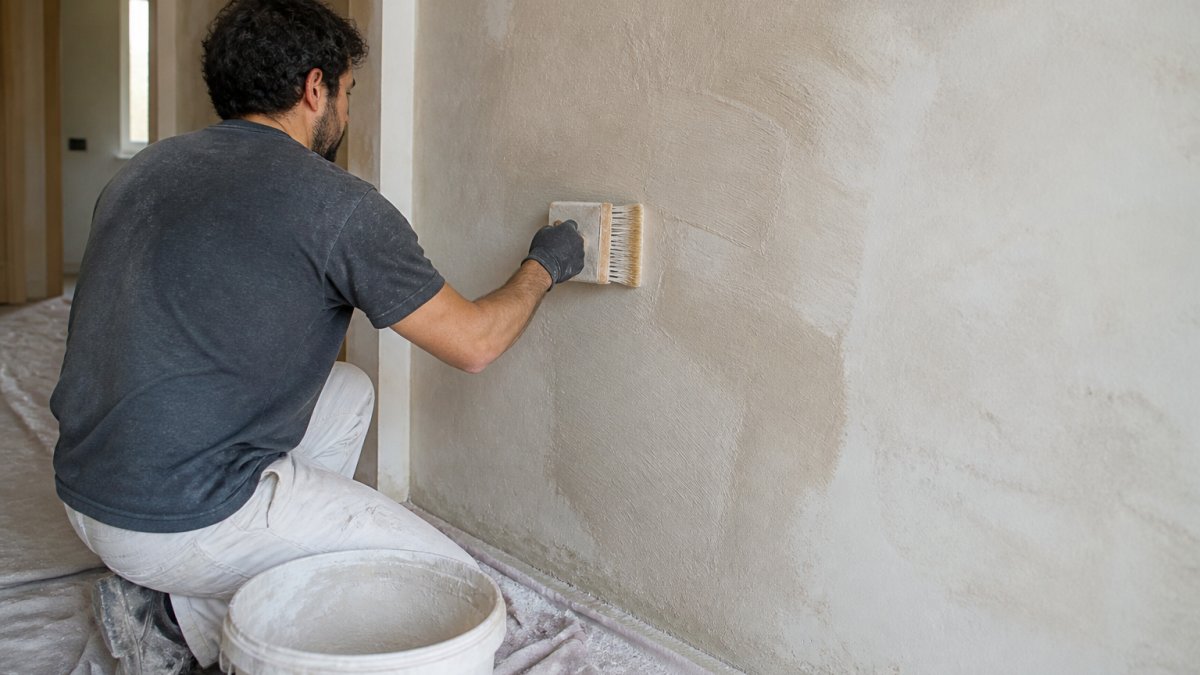
Dampen the plaster before you start. A dry, thirsty wall pulls moisture out of the finish too fast, leaving a chalky, uneven surface that will not cure properly.
Apply in thin, overlapping passes. Limewash is not a load-and-spread product. Work it into the surface rather than laying it on top.
A limewash brush is wide, block-shaped, and made for working the finish into a textured surface. A standard trim brush lays down too much product in too narrow a band and leaves visible tracks.
Cut in first, then roll or brush the field into the wet edge. Keep a consistent wet edge or you will see where one section dried before the next began.
Limewash durability on exterior walls is measured in years, not decades, and maintenance is part of the specification. That is not a defect. It is how mineral finishes work.
The finish cures by absorbing carbon dioxide and hardening over time. On a properly prepared exterior wall it holds up well against weather and resists mold because of its high pH, but it does not stay pristine without attention.
Expect to inspect exterior walls annually. Chalking, thin spots, and high-exposure areas will need a touch-up coat.
Wood cladding beats limewash when the design intent is a natural material that holds its shape, and Accoya modified wood is the specification to know.
That matters on exterior cladding, decking, windows, and doors.
Where limewash is a breathable mineral coating for masonry, Accoya is a substrate decision.
Accoya is easy to machine and finish, which keeps it inside normal carpentry workflow.
Rework on limewash and mineral finishes almost always traces back to four causes: wrong substrate, dry wall, heavy coats, and mixed batches. Each is preventable at the bid stage. Diagnose by symptom, because the fix depends on what you see on the wall.
| What You See | Most Likely Cause | Prevention | Remediation |
|---|---|---|---|
| Finish peels in sheets | Sealed, glossy, or acrylic-painted substrate | Adhesion test before crew mobilizes | Strip or mechanically open the surface, re-prime, re-apply |
| Chalky, dusty surface | Dry plaster pulled moisture from the finish | Dampen wall before every coat | Re-dampen, apply a thin reactivating coat |
| Cracking or crazing | Heavy single coat cured unevenly | Build thin layers, respect dry time | Sand back to sound finish, rebuild in thin coats |
| Visible lap marks | Wet edge dried before next pass | Continuous wet-edge discipline, two-person workflow | Re-wet the edge and blend, or re-coat the affected field |
| Color shift at a seam | Batches mixed mid-wall | Order full quantity in one batch | Re-coat the seam wall in a single batch |
| Patchy, uneven coverage | Too few coats or inconsistent load | Plan coat count from pigment load, not guesswork | Add a thin uniform coat over the field |
Mineral finishes are more forgiving to repair than film-forming coatings, but only if you respect two rules. Never patch a small area with a fresh batch and expect it to match an aged wall, feather the repair into a full elevation or accept a visible blend. And reactivating a drying edge with a mist of water is almost always faster and cheaper than sanding out a lap mark after cure.
Contractors who get mineral finishes right share one habit: they treat surface preparation as a line item, not an allowance. The crews that lose money assumed the wall was ready.
Every finish on this list fails somewhere; the job is choosing which failure you can live with. Limewash gives the look clients want and demands prep discipline. Silicate holds exterior color longer and punishes sloppy touch-ups.
The contractors who win these projects walk the wall, price the prep honestly, and order materials in one batch. That is the whole game.
Limewash is breathable and mineral-based, but it has real limitations. It requires more coats than conventional paint, so labor time adds up on large projects. Coverage can look patchy until fully cured, and color consistency varies between batches because of pigment load. It also needs a suitable substrate like plaster or masonry, and it will not perform well over sealed or non-porous surfaces. Contractors should factor in drying time and rework risk before bidding.
Compare substrate compatibility first, since plaster, masonry, and wood each need different prep. Then look at coverage per coat, pigment load, and how consistent the color stays across batches. Factor in labor time for cutting in, number of coats, and drying windows. Finally, check durability and maintenance expectations against the client's budget. A finish that saves on material but doubles labor rarely wins the job.
Accoya modified wood is a cladding and decking material, not a coating, so it replaces limewash only when the project calls for a wood exterior rather than a painted masonry finish. Accoya is acetylated for dimensional stability and long-term durability, and it machines and finishes easily. For exterior cladding, decking, windows, and doors, it removes the recoat cycle that limewash requires.
Start with the substrate: plaster and masonry suit limewash, while wood exteriors suit modified wood cladding like Accoya. Then weigh recoat intervals, maintenance access, and how the finish handles moisture. Limewash needs periodic touch-ups and stays breathable. Accoya holds its dimensions and needs less frequent refinishing. Match the finish to the client's maintenance tolerance and the building's exposure before you commit.