My shopping cart
Your cart is currently empty.
Continue ShoppingLast Updated: September 27, 2026
Buying building materials in bulk means purchasing construction supplies in large quantities at discounted per-unit pricing, typically through wholesale suppliers, trade accounts, or b2b marketplaces rather than at retail. For contractors, the payoff is straightforward: fewer purchase orders, lower unit costs, and fewer mid-project supply runs.
Volume discounts work because suppliers spread fixed costs, freight, and handling across larger orders. Tiered pricing is common: buy one pallet, pay one rate; buy five, pay less per unit. The retail markup you avoid is cumulative savings on every board, bag, and box.
Bulk buying backfires when storage, spoilage, or capital expenditure outweighs the discount. Over-ordering degradable materials or tying up cash in inventory that sits for months is a common mistake. If your timeline is short or storage limited, incremental purchasing often wins.
Wholesale construction supplies come from three channels: local distributors, online b2b marketplaces, and manufacturer-direct programs. Each has trade-offs in pricing, lead times, and vendor management overhead.
Local suppliers offer faster lead times, easier returns, and hands-on inspection. Online marketplaces beat them on price and selection but add freight costs and delays. For heavy materials like concrete systems and terrazzo, local pickup usually wins on total cost.
| Sourcing Channel | Best For | Main Trade-Off |
|---|---|---|
| Local distributors | Heavy materials, urgent jobs | Higher unit pricing |
| Online b2b marketplaces | Bulk hardware, fixtures | Freight costs, lead times |
| Manufacturer-direct | Large-volume projects | Minimum order quantities |
U.S. Small Business Administration guidance on supplier contracts
Contractor pricing for building materials is unlocked through trade accounts, which give you wholesale tiers and net payment terms. Qualifying usually requires proof of business, a resale certificate, and a minimum order history.
Start with a modest first order, establish payment reliability, then negotiate tiered pricing. Vendors reward consistent volume and on-time payment with better rates and priority allocation during shortages.
Construction material logistics covers how bulk orders move from supplier to jobsite, including freight costs, lead times, and handling. Getting this wrong erodes bulk savings faster than any pricing mistake.
Federal Motor Carrier Safety Administration rules on commercial freight
Onsite storage determines whether your bulk discount survives to installation day. Poorly stored materials lose value through moisture, warping, theft, and damage, usually silent until a crew opens a pallet and finds it unusable. Most guides stop at "keep it dry and covered," but the technical reality is more specific.
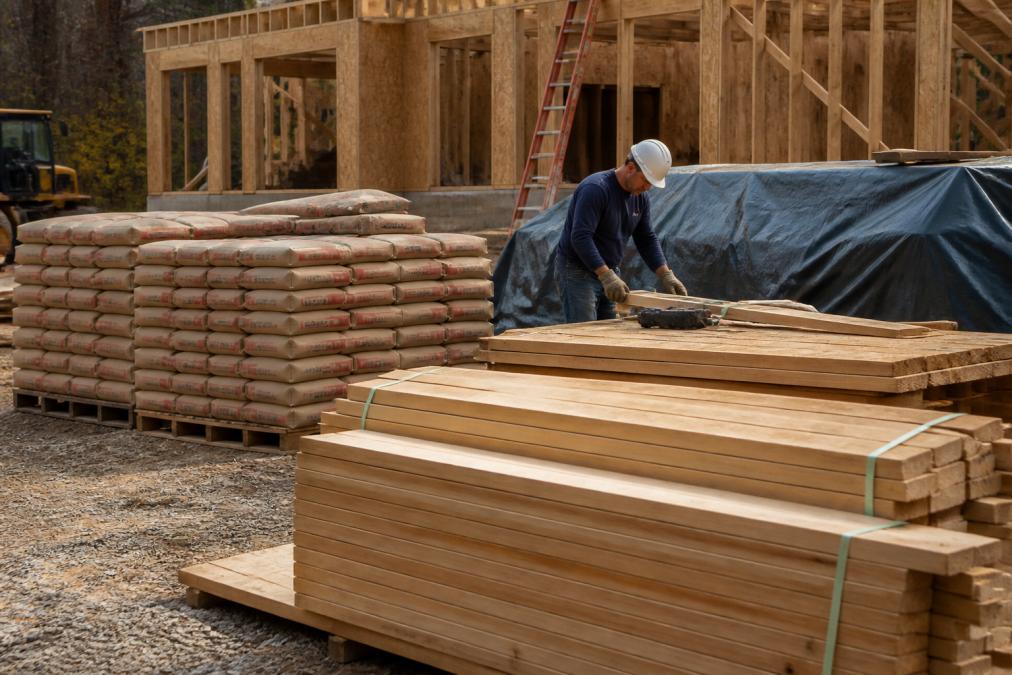
Moisture is the single largest destroyer of stored building materials. Gypsum, cement, and wood are hygroscopic: they absorb and release water vapor until they reach equilibrium with the surrounding air. Then cement bags set in the bag, drywall softens and grows mold, and lumber warps, cups, or splits.
Bulk orders concentrate value in one place, making them a target. Copper wire, tools, fixtures, and stacked lumber disappear from unsecured sites, and the loss usually exceeds the discount you negotiated. Practical controls include:
Not all materials age at the same rate. Cement loses strength the longer it sits, even sealed; lumber still moves with seasonal humidity; adhesives, sealants, and caulks have shelf lives measured in months. Rotate stock so older materials get used first, and date-stamp incoming pallets. The longer materials sit, the more likely they are to be damaged, forgotten, or rendered obsolete by a design change.
Over-ordering is the quiet cost of bulk buying. Leftover material leaves three paths: return it (only if the supplier allows and it's unopened), store it for the next job (only with dry, secure space), or dispose of it. Construction and demolition debris disposal is regulated in most states, and treated lumber, certain adhesives, and hazardous materials cannot go in a standard dumpster.
EPA guidance on construction and demolition debris management
Quality control and risk assessment separate a profitable bulk order from a costly one. Inspect deliveries before signing off, and understand the financial exposure of committing capital upfront. Bulk buying carries three distinct risks, quality, quantity, and price, and each needs its own control.
Once you sign a delivery receipt, you have generally accepted the shipment as delivered, and your leverage disappears. Inspect before you sign, and document what you find:
Bulk buying locks in pricing, but it also locks in cash. The risk isn't just money spent, it's money that can't be spent elsewhere. Tie up working capital in materials that sit for months, and you may lack cash for payroll, permits, or the next project's mobilization. That opportunity cost is real even when the materials are fine.
Three questions help size the risk before you commit:
Commodity materials, lumber, steel, cement, and copper, move with markets, and prices can swing meaningfully over a project's life. Locking in a bulk price protects you when prices rise but costs you when they fall. That's a genuine trade-off, not a free win.
Bulk buying pays off when you have storage, a clear project timeline, and verified supplier terms. Without those three, incremental purchasing is safer. Treat a bulk order as a financial commitment, not just a purchasing decision, and size it against your pipeline, cash position, and confidence in the takeoff.
Buying building materials in bulk rewards contractors who plan storage, logistics, and cash flow as carefully as pricing. The discount is real, but only if the materials arrive on time, stay intact, and get used.
You can buy in bulk from local lumber yards, specialty suppliers, big box stores with pro desks, and online B2B marketplaces. For professional-grade materials like European windows, concrete systems, and microcement, working directly with a specialized supplier gives you better contractor pricing and consistent quality. Compare freight costs and lead times before committing, since heavy materials like cement and terrazzo carry significant shipping expenses that can erase volume discounts if you source from far away.
Most suppliers require a business license, resale certificate, and a minimum order volume to open a trade account. Some offer tiered contractor pricing based on annual spend, so consolidating purchases with one vendor can move you into a lower price bracket. Ask about net payment terms and will-call pickup discounts too. Building a relationship with a local supplier often gets you better terms than anonymous online ordering, especially when you need technical support on specialty products.
It depends on your project pipeline and storage capacity. Bulk buying locks in volume discounts and protects against price increases, but it ties up capital and requires dry, secure onsite storage. If you have steady project flow and can forecast material needs accurately, bulk purchasing usually wins. For one-off jobs or materials with short shelf life, buying as needed reduces waste and avoids the risk of damaged or obsolete inventory sitting in your warehouse.
Freight costs, lead times, and delivery access matter as much as unit price. Heavy materials like concrete and terrazzo are expensive to ship, so local sourcing often makes more financial sense. Confirm whether the supplier delivers curbside or inside, and whether you need a forklift onsite. For imported products like European windows, factor in customs clearance and longer lead times. Always get delivery dates in writing and inspect shipments before signing off.